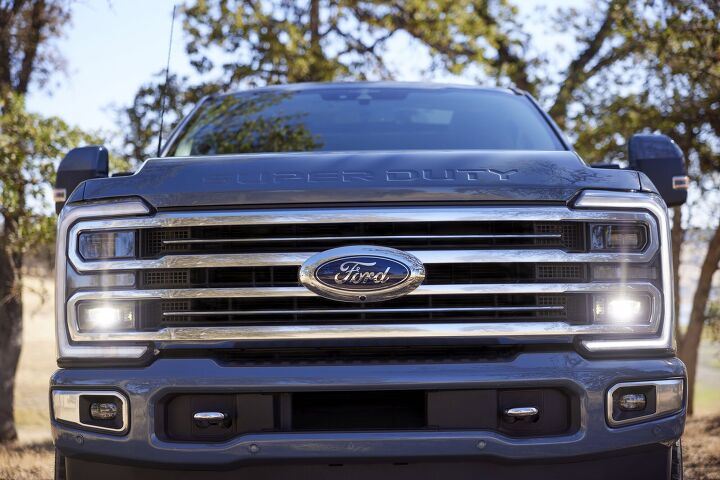
Ford Motor Company is making a dramatic return to the defense sector after a 36-year hiatus. The Blue Oval has officially secured a contract from the Department of Defense to develop prototypes for the U.S. Army’s next-generation light tactical vehicle program, aiming for what it describes as its largest military contract opportunity since the Cold War era.
The Pentagon is aggressively courting domestic automakers to leverage mass-production assembly lines and secure domestic supply chains, aiming to modernize military fleets following heavy hardware drawdowns in Europe and the Middle East. Under this program, the military is seeking around 600 heavy-duty tactical trucks built on existing commercial platforms.
The U.S. Army has awarded prototype development contracts to three builders: Ford, crosstown rival General Motors, and Utah-based specialized off-road outfitter BC Customs. The competitors are tasked with delivering operational vehicle prototypes for rigorous military field testing.
The military's operational criteria for the new vehicle are steep. The truck must be highly capable of transporting infantry squads and mission equipment across extreme, unpaved terrain. More importantly, it must function as a mobile, high-output power generation station. The on-board electrical architecture must be robust enough to charge fleets of surveillance drones, run tactical command-and-control communication rigs, and operate high-draw military gear directly from the vehicle’s power pack while deployed in remote zones.
Ford’s strategy leans heavily on its dominant consumer truck lineup. The automaker will manufacture three distinct prototypes utilizing the platform architecture of its existing F-Series Super Duty heavy-duty pickup trucks. By adapting an existing commercial platform that already features robust, mass-produced frames, powertrains, and electrical systems, Ford claims it can drastically accelerate development times and keep fleet acquisition costs significantly lower than purpose-built, ground-up military designs.
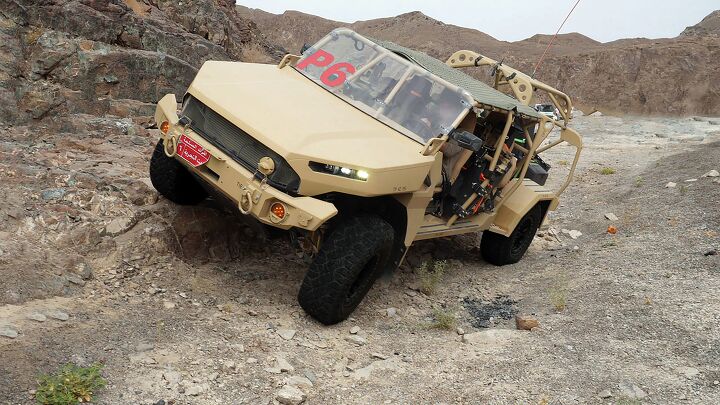
While Ford’s entry marks a high-profile return to the defense space, the company faces a steep uphill climb against General Motors. GM established its dedicated GM Defense subsidiary years ago and has already built an imposing footprint within the modern military logistics pipeline.
GM Defense is currently fulfilling an active multi-year contract supplying the U.S. Army with its midsize Chevrolet Colorado-based Infantry Squad Vehicle (ISV), with over 1,000 units already delivered. For this heavy-duty contract, GM is already well ahead of the curve. The company has spent the last two years developing a heavy variant dubbed the "ISV-Heavy," built directly on the bones of the Chevrolet Silverado HD. The Pentagon has already purchased early iterations of GM's V8-powered military truck and has been subjecting it to rigorous field trials.
Ford was once an absolute juggernaut of military manufacturing, acting as a crucial pillar of domestic vehicle output during World War II, the Korean War, and the Vietnam War. It played an instrumental role in mass-producing the original military "Jeep" and building heavy bombers at its Willow Run plant. However, Ford completely exited the defense space in 1990 when it sold its Ford Aerospace missile and electronics division to Loral Corporation.
via Autobuzz Today
Comments
Post a Comment