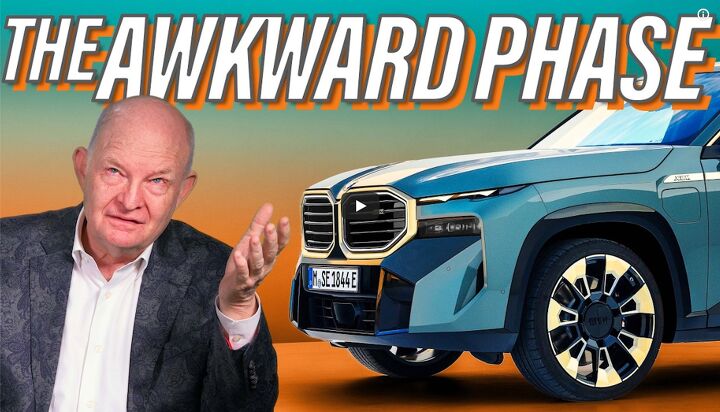
In our not-so-humble opinion, BMW design has gone off the rails. Automotive expert Jim Hall examines the history of this German luxury car brand and helps us peer into the future of the automaker.
Once a hallmark of elegant styling, BMW is facing an identity crisis. When your middle name is literally "motoren" (engine) and internal combustion powertrains are facing extinction, what do you do? BMW's iconic twin kidney grille no longer serves a purpose, yet it has deformed and inflated to the shape and size of an unsightly goiter. Meanwhile, the competition and one-upmanship from Mercedes-Benz is as strong as ever. Where do BMW cars and SUVs go from here?
The TTAC Creators Series tells stories and amplifies creators from all corners of the car world, including culture, dealerships, collections, modified builds and more.
A transcript, cleaned up by AI and edited by a human staffer, is below.
[Image: YouTube Screenshot]
Become a TTAC insider. Get the latest news, features, TTAC takes, and everything else that gets to the truth about cars first by subscribing to our newsletter.
Summary: “What Is Going On With BMW Design?” – Jim Hall Explains
In this discussion, automotive analyst Jim Hall argues that BMW's controversial recent designs are not simply a styling problem—they are the result of the company trying to redefine itself in an era of electrification, changing consumer preferences, and shifting brand identity.
BMW's Core Identity Is Under Threat
Hall's central argument is that BMW has historically been an engineering company built around engines.
- BMW's roots are in aircraft engines, motorcycles, and high-performance automotive powertrains.
- The company's reputation was tied to driving dynamics and engine development.
- Electrification removes one of BMW's biggest differentiators because electric motors are becoming increasingly similar across manufacturers.
This creates a fundamental question:
If BMW can no longer distinguish itself primarily through engines, what makes a BMW a BMW?
The Shift from Driving Machine to Luxury Brand
Hall argues that many buyers today purchase BMWs for the badge rather than the driving experience.
- In major global markets, brand prestige increasingly matters more than handling characteristics.
- BMW has had to evolve from selling "the ultimate driving machine" to selling a recognizable luxury brand.
- Electrification accelerated this transition.
As a result, BMW began emphasizing visual identity over traditional engineering identity.
Why the Grilles Keep Getting Bigger
One of the most controversial BMW design trends is the oversized kidney grille.
Hall explains the irony:
- Electric vehicles need less cooling.
- Modern vehicles increasingly block off their grilles for aerodynamic efficiency.
- Yet BMW's grille is one of its strongest brand identifiers.
Therefore:
- Rather than shrinking the grille because it is less functional,
- BMW enlarged it because it is more important as a branding element.
The grille has become a logo rather than an engineering necessity.
BMW's "Golden Age"
Both hosts agree that BMW's late-1990s and early-2000s lineup represented a high point.
Key examples:
- BMW E46 3 Series
- BMW E39 5 Series
- BMW E38 7 Series
Why they worked:
- Clean proportions.
- Evolutionary styling.
- Strong family resemblance.
- Excellent driving dynamics.
- Clear BMW identity.
The downside was that the cars sometimes looked too similar to each other.
The Turning Point: The Bangle Era
Hall sees the introduction of the:
- BMW E65 7 Series
as the major inflection point.
The controversial rear styling ("Bangle Butt") was partly driven by:
- Aerodynamic requirements.
- Crosswind stability testing.
- The need to manage airflow around a larger luxury sedan.
Hall argues that many enthusiasts dismissed the design without understanding the engineering constraints behind it.
iDrive Was the Bigger Revolution
Hall believes the most important change wasn't the exterior styling — it was iDrive.
The original iDrive attempted to:
- Reduce driver distraction.
- Consolidate vehicle functions into one controller.
- Allow operation without reaching for many switches.
The problem:
- BMW engineers kept adding more functions.
- Simple tasks became buried in menus.
- Usability suffered.
Hall notes that many modern vehicles still struggle with the same issue.
Modern BMW Interiors
Using the:
- BMW XM
and current:
- BMW 7 Series
as examples, Hall argues that BMW interiors have become:
Strengths
- Premium materials.
- Bold colors.
- Advanced technology.
- Sophisticated lighting.
Weaknesses
- Overly busy aesthetics.
- Heavy reliance on screens.
- Fewer traditional BMW cues.
- Less focus on the driver compared with older BMWs.
His criticism is that many new BMW interiors feel luxurious but not uniquely BMW.
The XM as a Symbol of the Problem
The BMW XM receives significant criticism.
Hall argues that:
- Excessive styling elements clutter the design.
- Decorative trim appears arbitrary.
- Traditional BMW visual cues have been diluted.
- BMW is experimenting with a new visual identity but hasn't fully succeeded.
The XM represents BMW trying to define what a luxury performance vehicle should look like in a post-internal-combustion future.
BMW's Future: Neue Klasse
Hall is cautiously optimistic about BMW's upcoming:
- BMW Neue Klasse
vehicles.
Positive trends include:
- Cleaner surfaces.
- Simpler body shapes.
- Better visibility.
- Less unnecessary detailing.
- More cohesive design language.
However, he worries that:
- The vehicles may become less instantly recognizable as BMWs.
- Traditional brand identifiers are being reduced or reinterpreted.
- BMW still needs a compelling answer to what makes its electric cars uniquely BMW.
Final Conclusion
Jim Hall's view is that BMW's controversial styling is not random or the result of bad designers.
Instead, BMW is facing a difficult challenge:
- Its historical identity was built around engines and driving dynamics.
- Electrification weakens those traditional advantages.
- Buyers increasingly purchase luxury brands for image and status.
- BMW is trying to create a new visual and experiential identity for the electric era.
The oversized grilles, radical styling, screen-heavy interiors, and experimental concepts are all symptoms of a company attempting to redefine itself while preserving enough of its heritage that customers still recognize it as BMW.
The question, Hall concludes, is not whether BMW can redesign its cars — it is whether customers will accept BMW's new definition of what a BMW should be.
via Autobuzz Today
Comments
Post a Comment