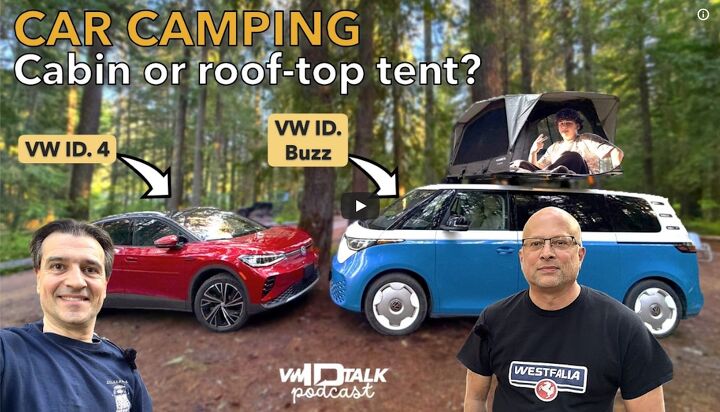
Welcome back to another episode of the VW ID Talk podcast! In this episode, we are taking the ID.4 and the ID. Buzz out for an ultimate EV camping field test.
We are completely transforming the ID. Buzz by testing out the Dometic TRT 140 AIR rooftop tent for the first time. We break down the three different sleeping setups: Ethan takes the inflatable "penthouse suite" on the roof, Dilip tests the "first floor" of the Buzz alongside a cool custom kitchen box, and I test out a regular mattress in the back of the ID.4. In this episode, we cover:
- Setting up the Dometic TRT 140 AIR rooftop tent and getting it to that perfect 9 PSI.
- Measurements and headroom comparisons between the ID.4 and the ID. Buzz.
- Overnight EV battery drain (Spoiler: Heating the Buzz overnight only used 4% of the battery!). - The realities of car camping: morning condensation, blocking out sunlight, and whether you really need custom window shades.
Hit subscribe for more EV deep dives, multi-brand retrofits, and ID series adventures!
The TTAC Creators Series tells stories and amplifies creators from all corners of the car world, including culture, dealerships, collections, modified builds and more.
A transcript, summarized by AI and edited by a staffer, is below.
[Image: YouTube Screenshot]
Become a TTAC insider. Get the latest news, features, TTAC takes, and everything else that gets to the truth about cars first by subscribing to our newsletter.
Summary: Camping in an ID. Buzz Rooftop Tent vs. Sleeping Inside an ID.4
In this episode of the VW ID Talk podcast, the hosts and guest Dilip conduct a real-world camping experiment comparing three overnight sleeping setups:
- A rooftop tent mounted on an ID. Buzz
- Sleeping inside a Volkswagen ID.4
- Sleeping in the lower cargo area of the ID. Buzz
The goal is to determine which setup provides the best night's sleep.
Setting Up the Rooftop Tent
Dilip demonstrates the setup of a Dometic TRT 140 AIR rooftop tent mounted on his blue ID. Buzz.
Key observations:
- Setup is remarkably simple compared with traditional tents.
- The tent unfolds from its hard shell and uses an inflatable air-frame design.
- Inflation requires a pump set to approximately 9 PSI.
- Initial setup difficulties stem from selecting the wrong hose nozzle, highlighting the importance of practicing at home before a camping trip.
- Once connected properly, the tent inflates in just a few minutes.
The hosts praise the ease of setup, noting how modern rooftop tents eliminate the hassle of poles and complex assembly.
Rooftop Tent Interior
After inflation, the group explores the tent.
Measurements include:
- Length: approximately 87 inches (220 cm)
- Width: approximately 54 inches (140 cm)
- Interior height: approximately 37 inches (93 cm)
Highlights:
- Plenty of room for two occupants.
- Large screened windows provide ventilation and views.
- Elevated position creates a "penthouse suite" feel.
- Mattress is firm but generally considered better than sleeping on the ground.
The ID. Buzz owner also showcases a compact camping kitchen setup stored inside the van, including:
- Cooler
- Water system
- Drawers for cooking equipment
- Storage for pots, pans, and utensils
The ID.4 Sleeping Setup
The host sleeps inside an ID.4 using:
- A full-size household mattress approximately 25 cm (8–9 inches) thick
- Rear seats folded flat
- No rooftop tent
Measurements inside the ID.4:
- Narrowest width: approximately 100 cm (39 inches)
- Height: approximately 55 cm (22 inches)
The host is optimistic that the thicker mattress may compensate for the tighter quarters.
Overnight Conditions
Conditions during the night:
- Temperature around 50°F (10°C)
- No severe weather
- Cabin heating used intermittently
The ID.4's climate control was activated overnight and again in the morning using the smartphone app.
Battery impact:
- Approximately 4% battery consumption from heating and defogging.
Morning Results
ID.4 Experience
The host reports:
Pros
- Slept very comfortably.
- Thick mattress made a significant difference.
- Climate control and remote activation worked well.
- Built-in storage pockets were useful for glasses and personal items.
Cons
- Limited headroom; sitting upright wasn't possible.
- Some window coverings would have improved privacy and light blocking.
- Condensation and fogging required use of climate control in the morning.
ID. Buzz Lower-Level Sleeping Area
Dilip slept in the lower section of the ID. Buzz.
His assessment:
- Comfortable sleep overall.
- Scheduled heating sessions worked as intended.
- WeatherTech window shades helped with privacy and insulation.
- Little concern about battery drain from interior lights; climate control is the larger energy consumer.
Rooftop Tent Experience
Dilip's son Ethan slept in the rooftop tent.
His verdict:
Pros
- Spacious interior.
- Excellent darkness and light blocking.
- Plenty of room to move around.
Cons
- Mattress felt somewhat hard.
Lessons Learned
The group concludes that:
- Practice setting up rooftop tents before traveling.
- Program climate-control schedules before bedtime.
- Avoid turning on vehicle ignition late at night, as headlights can disturb neighboring campers.
- Window shades or eye masks help reduce morning light intrusion.
- EV climate-control systems make vehicle camping significantly more comfortable.
Overall Conclusion
All three sleeping arrangements proved viable:
- ID.4 with a quality mattress delivered the most comfortable sleep.
- ID. Buzz rooftop tent offered the most space and traditional camping experience, though the mattress could be improved.
- ID. Buzz lower sleeping area provided a comfortable middle ground with good weather protection and convenience.
The experiment demonstrated that both the ID.4 and ID. Buzz can serve as capable camping vehicles, especially when paired with thoughtful accessories like rooftop tents, climate control scheduling, window shades, and proper bedding.
via Autobuzz Today
Comments
Post a Comment