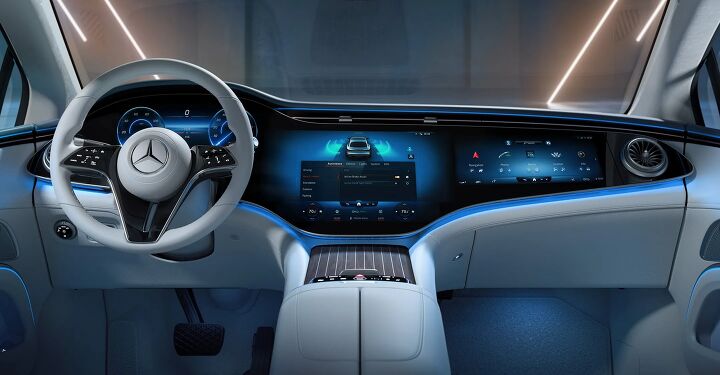
As of July 7, 2026, the second phase of the European Union’s General Safety Regulation (GSR2) mandates that every newly registered passenger car and light commercial van must be equipped with an Advanced Driver Distraction Warning (ADDW) system.
This means that a cabin-facing camera will actively monitor the driver's face, eyes, and head positions during every journey.
Welcome to the panopticon.
While Eurocrats pitch the mandate as a vital safety measure designed to eliminate traffic accidents caused by drowsiness and distraction, the law erases any semblance of automotive occupant privacy. Up until this point, a vehicle owner could reasonably assume their in-cabin behavior was private. That freedom is now dead, replaced by an always-on automated surveillance suite that can never be permanently deactivated.
The ADDW setup works via an infrared (IR) camera module positioned directly on the steering column or within the upper dashboard cluster. By deploying active infrared illumination that remains invisible to the human eye, these sensors track eye movements, eyelid blink frequencies, and precise gaze directions in both pitch-black and bright conditions.
If the software determines that the driver has looked away from the road—such as glancing down at a mobile device or adjusting an infotainment screen—for more than 6.0 seconds at speeds between 12 and 31 mph the vehicle is legally required to intervene. At speeds exceeding 31 mph, the window shrinks to just 3.5 seconds before the system triggers visual, audible, or haptic dashboard alerts.
While the first-generation legislation only dictates escalating alarms and does not yet force some kind of physical vehicle intervention like automatic emergency braking or a mandatory shoulder stop, the system cannot be permanently bypassed.
Individual manufacturers may allow drivers to mute the audibles through sub-menus, but the regulation mandates that the entire distraction monitoring system fully re-arms itself at every ignition cycle. Early consumer feedback indicates severe fatigue from false alarms triggered by normal actions like mirror checks, changing a radio station, or checking out that hot chick crossing the road.

European lawmakers have attempted to preempt inevitable public backlash by wrapping the legislation in strict data privacy guardrails—although that attempted short-circuiting misses the point entirely of why people aren't enthused about losing their privacy.
The official text dictates that the ADDW system must operate within a strict "closed loop," meaning all telemetry and biometric evaluations must occur locally on the car’s internal computer chip. The law explicitly bans continuous video recording, blocks the use of facial recognition to verify identity, and stipulates that all data be wiped immediately after real-time processing. All well and good, but this line of thinking locks you into a framed argument where surveillance is the only outcome; the benevolent bureaucrats are doing you the favor of protecting your privacy while your privacy is being violated. It's like negotiating with a toddler.
Worse, the regulation lacks any independent, third-party auditing framework to guarantee that automakers are actually adhering to the closed-loop rule. In fact, Volvo already admitted that its own driver-monitoring setup transmits telemetry back to external cloud servers to train safety algorithms, directly exposing a massive gap in the regulatory firewall.
With connected vehicles already jammed full of factory cellular modems and over-the-air update capabilities, the physical hardware is already there—It would take nothing more than a simple over-the-air software flash to turn these cameras into commercial data harvesters for insurance companies, fleet managers, or government agencies seeking behavioral risk profiles. Something automakers have already done with less sophisticated tooling.
The solution is to obviously stop buying cars.

You shouldn't dismiss this just because you live in the United States does not mean you should dismiss this.
American safety regulators are moving down a similar path. Driven by legislative directives to combat distracted and impaired driving, the National Highway Traffic Safety Administration (NHTSA) has been actively studying mandatory in-cabin monitoring.
Plus, automakers absolutely hate engineering and maintaining separate, highly complex electrical and interior architectures for different global markets. Because the physical infrared cameras, sensor housing, and core algorithms are now baked directly into the global manufacturing platforms of major automakers to satisfy European law, the incremental cost of dropping the exact same hardware into U.S. vehicles would be virtually zero—and conveniently offer another excuse to increase MSRP by a few thousand bucks.
As cars become increasingly dominated by outsized digital displays that inherently pull a driver’s eyes away from the road, regulators are backing us into a corner where internal cameras are the only counterweight available.
The question for American buyers is no longer if a dashboard camera will be watching their face, but whether the technology will be used to underpin a new era of corporate and state automotive surveillance.
I think we all know the answer.
Become a TTAC insider. Get the latest news, features, TTAC takes, and everything else that gets to the truth about cars first by subscribing to our newsletter.
via Autobuzz Today
Comments
Post a Comment